
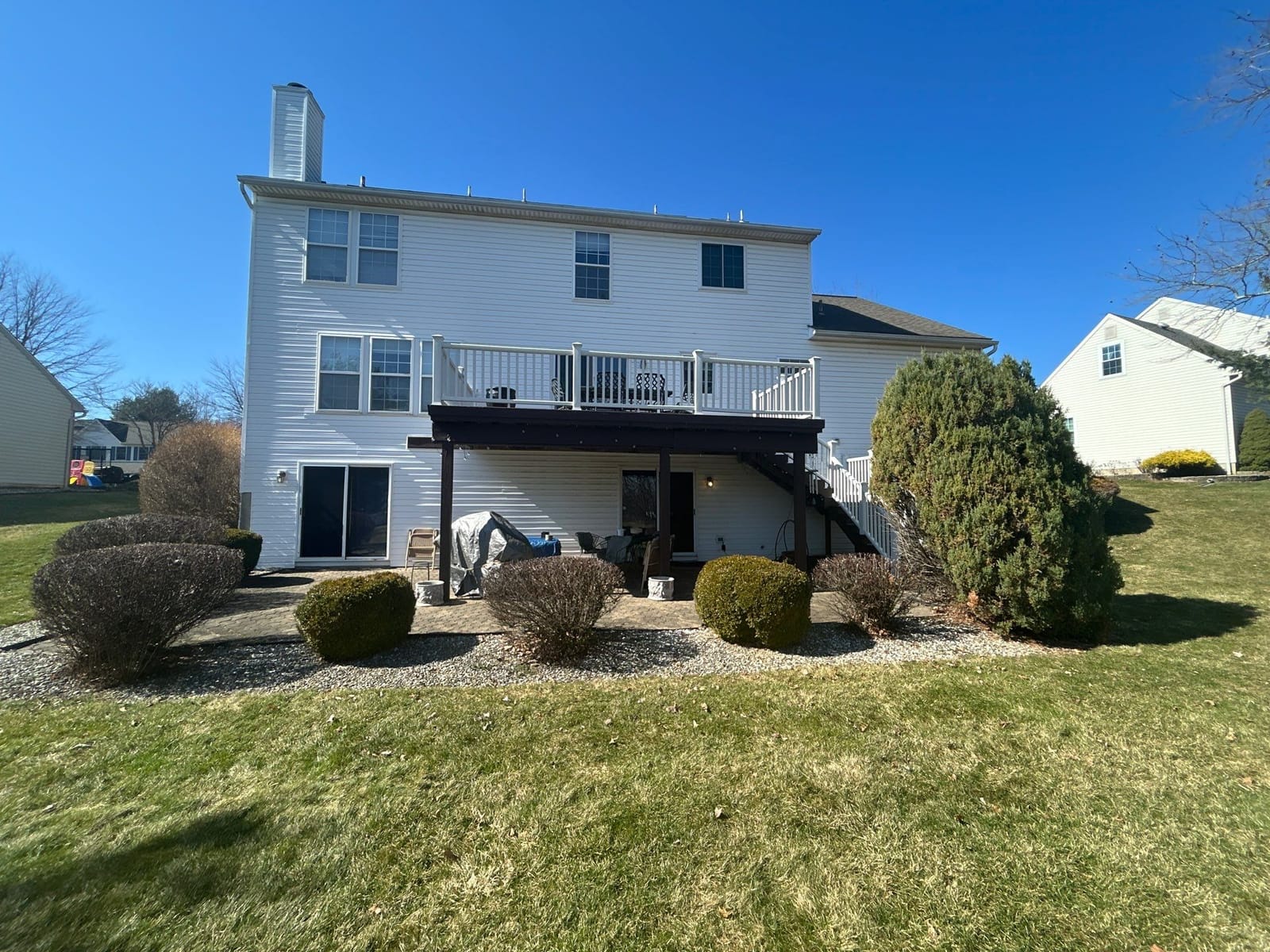
For a lot of homeowners in New Jersey, Pennsylvania and New York, Trex decking is worth it if you plan to stay put for many years and don't want to stain and seal a deck every few summers. It costs more up front than pressure-treated wood, often a lot more. But it skips most of the yearly upkeep wood needs in our wet, freezing winters. If you're on a tight budget, selling soon, or don't mind the maintenance, pressure-treated wood can still be the smarter buy.
Here's how cost, upkeep, lifespan and Northeast weather should factor into your choice.
What you're actually comparing
Trex is a brand of composite decking. Composite boards are a blend of wood fibers and plastic, and many lines have a protective outer shell. Pressure-treated wood is usually southern yellow pine treated with chemicals to resist rot and insects.
Here's what a lot of people miss: on most composite decks, the frame underneath is still pressure-treated wood. The joists, beams and posts are usually the same either way. So you're mostly choosing the deck boards, stairs and railings you see and walk on.
That matters because the frame often decides how long the whole deck lasts. A composite surface on a poorly built frame won't save you.
Cost: upfront price vs. long-term spending
Prices swing a lot with region, materials, deck size, height and design. Labor in the New York City and North Jersey areas tends to run higher than in rural Pennsylvania. With that in mind, these are rough installed ranges many Northeast homeowners see:
- Pressure-treated wood deck: about $25 to $50 per square foot installed
- Trex or similar composite deck: about $45 to $90 per square foot installed
On a 300-square-foot deck, that's roughly $7,500 to $15,000 for wood and $13,500 to $27,000 for composite. Railings, stairs, lighting and permits can push either number higher.
Then there's upkeep. A wood deck in the Northeast usually needs cleaning and a fresh coat of stain or sealer every 2 to 3 years. If you do it yourself, figure a few hundred dollars in supplies and a couple of weekends. Hiring a pro often runs from several hundred to a couple thousand dollars each time, depending on size and condition.
Over 15 to 20 years, those sealing jobs add up. They can close some of the price gap, but often not all of it. What composite really buys you is less work and a more even look over time. It isn't always cheaper in total.
About the author
CrewVisto Editors
Guides and news for contractors and homeowners from the team behind CrewVisto.
This article is general information. Codes, prices and warranties vary by town and product; have a licensed contractor look at your situation before you start.
Comments
Loading comments…